Projects · 13 November 2026 · 5 min read
The wind organ on Trovro: an instrument played by the wind
On a hill above Rogotin, near Ploče, stands the world's first wind organ. It is played by the bura, the jugo and the maestral, and its pipes were made in our workshop.
In more than two decades of working on organs, almost every job has had the same frame: a church, a choir loft, an instrument and an organist. Then a call came from the Neretva valley. We were asked to make pipes for an organ that would stand in no church and would be played not by a person, but by the wind.
The idea of Željko Škorić
The wind organ was conceived by Željko Škorić, a civil engineer from Ploče. He carried the idea for years. About ten years passed from the first concept to the moment the organ first sounded, and the local portal Rogotin.hr has even kept an old photograph of him climbing Trovro, long before any construction, to check whether anything could be built there at all.
In 2017 the project was submitted under a county programme for promoting the sustainable development of the natural heritage of the Neretva valley, financed largely with European funds. The Dubrovnik-Neretva County was the lead partner and many people were involved alongside the Town of Ploče. Without the persistence of the man who devised it all, there would have been nothing.
Where it stands
Trovro is a hill 114 metres above Rogotin, a small place between Ploče and Metković. From the top you can see the mouth of the Neretva, the delta, the surrounding hills and the Pelješac peninsula. A stone-paved path about 900 metres long leads up, and a viewpoint and a dry-stone plateau have been built alongside the organ.
How it is built
- Three concrete structures, each 15.5 metres long, face three winds: the bura, the jugo and the maestral.
- Each holds seven pipes, 21 in total.
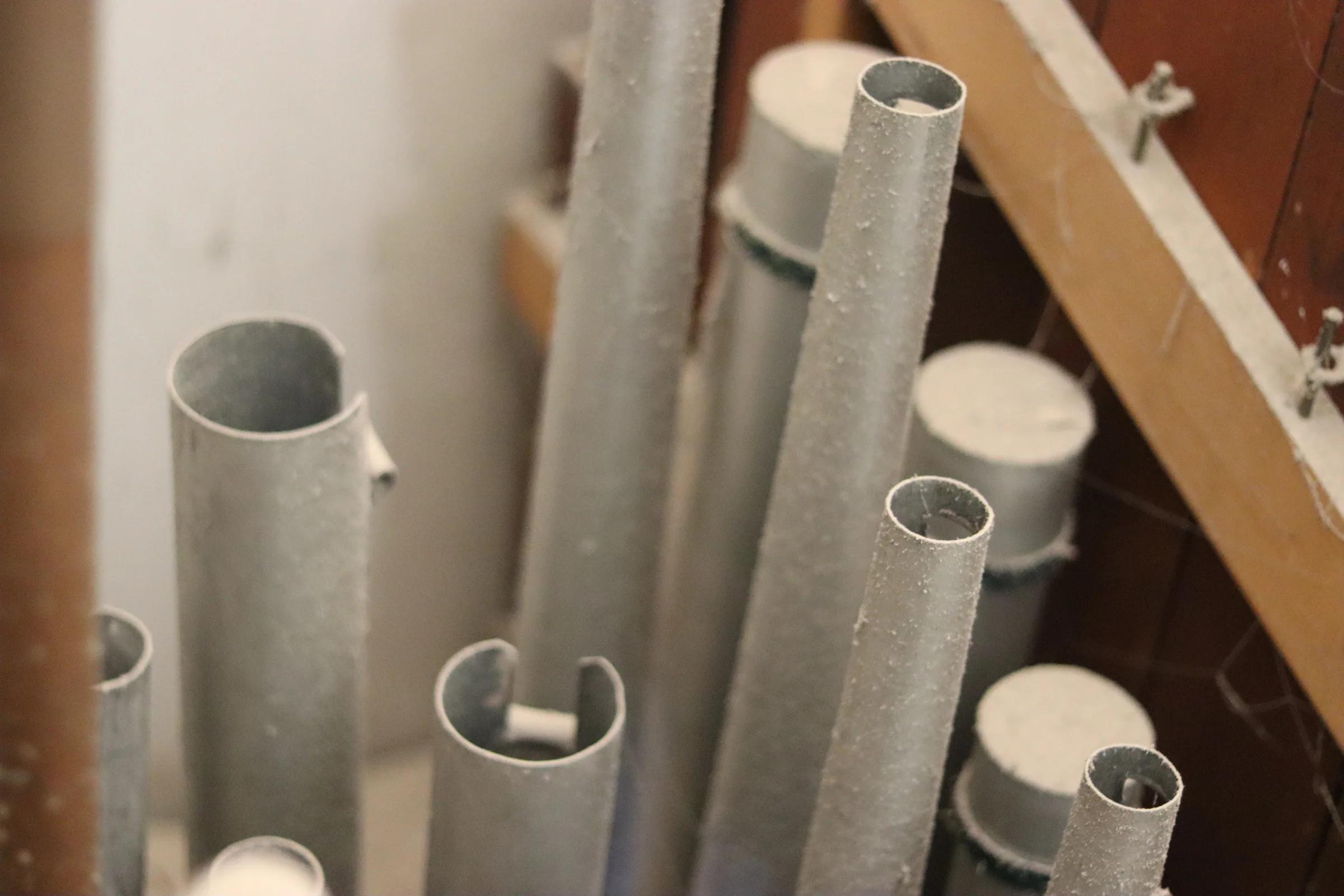
- The pipes are made of 316 stainless steel, which withstands salt and the weather by the sea.
- The pipes are closed (stopped) and tuned so that the seven notes together form a pleasant harmony rather than random noise.
- Dampers limit the airflow so that the organ does not howl in strong wind.
The concrete work was carried out by the Dubrovnik company Trag, and the position was chosen using wind data for the site. The musical part, the pipes, was made in our workshop near Koprivnica. It took about half a year, and in April 2020 we delivered and installed them on site. The Slovenian organ builder Škrabl also took part in the project.
Why it is different from a church organ
The principle is the same as for any pipe: the longer it is, the deeper the note, and the shorter it is, the higher. Everything else is different. In a church the bellows provide a calm, steady air pressure, so a pipe speaks the same way every time. On the hill the pressure is set by the wind, which changes from second to second. So nothing here could be copied from existing instruments. We had never done work like this before and we put into it everything we know about pipes.
According to the HRT broadcast report, the organ already sounds when the wind blows at about 2.7 metres per second. Because the direction and strength of the wind are constantly changing, the music never repeats.
One of a kind in the world
The inspiration was the Sea Organ in Zadar, played by the sea. Here the wind plays, and from three directions. The wind organ on Trovro is the first and only of its kind in the world and has also been featured in international television exchange. It is a project we are especially proud of, and we are glad that our signature is on it.
If your travels take you to the Neretva valley, climb Trovro. Best when the wind is blowing.